
 There
are various practical aids to progress in japa meditation
that have been tested for thousands of years and are based
on sound psychological and natural principles.
There
are various practical aids to progress in japa meditation
that have been tested for thousands of years and are based
on sound psychological and natural principles.
The
telling of rosary beads is the form of japa most familiar
to Western experience. A japa mala, similar to rosary, is
often used in Mantra repetition. It helps to foster alertness,
acts as a focus for the physical energy and is and aid to
rhythmic, continuous recitation. It consists of 108 beads.
An additional bead, the meru, is slightly larger than the
others. It is the signal indicating that with one Mantra
recited for each bead, japa has been done 108 times, or
one mala. The fingers should not cross the meru. When it
is reached, the beads are reversed in the hand; one continues
reciting the Mantra, moving the mala in the opposite direction.
The thumb and the third finger roll the beads; the index
finger, which is physically negative, is never used. The
rosary must not be allowed to hang below the navel, and
should be wrapped in a clean cloth when not in use.
An
appropriate prayer before beginning induces purity of feeling.
Wit eyes closed and concentration focused either between
the eyebrows on the ajna chakra or on the anahata chakra
of the heart, one should invoke the aid of his chosen deity
and guru. The Mantra must be pronounced distinctly and without
mistakes, for it and the deity itself are one and the same
thing. Repetition must be neither too fast nor too slow,
and thought must be given to its meaning. Speed should be
increased only when the mind begins to wander. Because the
mind will naturally try to drift away after a time, it is
necessary to keep alert throughout the practice.
Variety
in japa is necessary to sustain interest, avoid fatigue
and counteract the monotony that can arise from constant
repetition of the same syllables. This can be provided by
modifying the volume. The Mantra can be repeated aloud for
a while, then whispered, and then recited mentally. The
mind needs variety or it becomes tired. However, even mechanical
repetition that is devoid of feeling has a great purifying
effect. Feeling will come later, as the process of purification
continues.
Audible
repetition is called vaikhari japa, while that done by whispering
or humming is termed upamsu japa. The Mental repetition,
manasika japa, is the most powerful; it requires keener
concentration, for the mind tends to shut off after a period
of time. The advantage of loud japa, which should be used
with discretion, is that it shuts out all worldly sound
and distractions. One should alternate when necessary, particularly
when drowsiness sets in.
Unaccustomed to this kind of activity, the beginner at first
may find himself giving up too soon, after five or ten minutes
of repeating the Mantra. The syllables in this case may
sound meaningless--mere syllables and nothing more. But
by persevering for at least half and hour without interruption,
he will give the Mantra time to work itself into his consciousness,
and benefits will be felt in a few days.
Meditation on the image of the chosen deity while the Mantra
is being repeated adds tremendously to the efficacy of japa.
Sound and form correspond and reinforce each other. Sound
vibrations alone, if made with care and devotion, are capable
of producing the form in the consciousness of the aspirant.
The process can be greatly facilitated by visualizing the
deity in the heart area or the space between the eyebrows.
With the visualization, there should be awareness of the
various attributes of the deity. Feel that the Lord is seated
within, emanating purity to the heart and mind, and manifesting
his presence by the power of the Mantra.
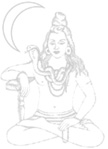
Thus, in meditating on Siva, the physical energy is focused
on rolling the mala beads. The image of the deity, with
the third eye and the symbolic crescent moon, serpents,
trident, drums, etc. occupies the mind on one level. The
Mantra OM Namah Sivaya is simultaneously being repeated,
and on another level is being embedded in the consciousness.
Repetition of Mantra has a cumulative effect, and with continued
practice it gains in power. It should be evident that japa
meditation is far more than a verbal exercise. It is a state
of complete absorption.
Concluding
prayer and rest are important. When japa practice is finished,
it is advisable not to plunge immediately into worldly activity.
Sitting quietly for about ten minutes, one should reflect
on the Lord and feel His presence. As routine duties are
commenced, the spiritual vibrations will remain intact.
This current should be maintained at all times, no matter
what one is engaged in.
Mantra
writing, likhita japa, is another, supplementary form of
japa. The Mantra should be written with a special pen and
notebook, which have been set-aside for this purpose. It
should be done for half an hour, during which time complete
silence and concentration are observed. While writing, simultaneously
repeat the Mantra mentally so that the impression made in
the consciousness will be intensified. Likhita japa may
be done in any language or script. It greatly helps the
aspirant to concentrate and leads to meditation. This practice
helps to set up a continuous vibration of divine energy
that guides and protects, regardless of what one is doing.
Advanced
meditation should not be attempted without the guidance
of guru. Bija Mantras and certain mystic Mantras, such as
the Sri Vidya, should not be repeated by those who are not
well acquainted with them and with the Sanskrit language.
When improperly repeated, they can actually bring harm to
the psychic system. Those who are not qualified, and who
do not have access to a guru, who has broken the power of
these advanced Mantra, should concentrate on their own Mantras.
Deity
Mantras are used for purascharana, which is concentrated
japa meditation extended over a long period of time. When
performing a purascharana, the aspirant sets aside a number
of hours each day for japa. The Mantra is repeated 1,00,000
times for each syllable of the Mantra. The Mantra is repeated
with feeling, and in a particular manner with the right
observance, until the fixed number of Mantras has been recited.
Slow repetition of Maha Mantra may take as long as three
years to finish. The practitioner must observe certain rules
and regulations lay down in the scriptures in regard to
purascharana and must observe perfect dietary discipline
in accordance with those injunctions.
Anushathana
is the practice of religious austerity for the sake of obtaining
some object or goal, the highest being spiritual. For the
success, the desire should be spiritual, and it should be
kept in view throughout the practice. The rigor of the austerity,
which may be various kinds, depends on the constitution
and health of the aspirant.
For
japa anushathana, a deity Mantra should be selected in accordance
with the desired goal. Although his personal deity might
be Krishna, if one wanted to compose sublime music, he would
repeat the Mantra for Saraswati; if he wished his spiritual
obstacles to be removed, he would select a Ganesha Mantra.
Japa meditation is then performed for a protracted period,
with intense concentration of mind and no thought of the
external world. This leads to achievement of the desired
goal.
There may be other types of japa meditation, but the broad
theory and techniques do not greatly vary. Approached with
faith and devotion, and carried out with perseverance, japa
is the most direct path to God-Realization.
Saguna Mantra
